




When you’re comparing security doors, it’s easy to focus on the mesh, grille or frame. But there’s another component that plays an equally important role: the lock.
You might have seen terms such as “single-point lock” and “triple-point lock” while comparing security doors and wondered what the difference actually means.
Does a triple-point lock automatically make a door more secure? Is a single-point lock ever enough? And which locking option should you choose for your home?
The answer depends on what you’re trying to achieve.
Prowler Proof offers both single-point and triple-point locking options, but they’re designed for different applications. Understanding how each works can help you choose the right security door for your home.
What is a single-point lock?
As the name suggests, a single-point lock secures the door at one point.
On a Prowler Proof security screen, the single-point lock option is intended for situations where security isn’t the primary consideration and you simply need a non-security door.
Prowler Proof’s Whitco Tasman single-point lock is available on hinged doors across ranges including ForceField, Protec, Diamond and Insect. It features DualSelect® operation, giving you the choice between privacy and deadlock functions.

When might a single-point lock make sense?
A single-point lock can be a practical option when the primary purpose of the screen is to provide a physical barrier rather than security against forced entry.
For example, you may want a screen door that allows airflow and keeps insects out, but you don’t require the additional security provided by a multi-point locking system.
This is why Prowler Proof describes its single-point option as being suitable when security is not a priority.
It’s not necessarily about one lock being “bad” and another being “good”. It’s about matching the locking system to the purpose of the door.
What is a triple-point lock?
A triple-point lock secures the door at three separate points rather than one.
Instead of relying on a single locking point in the middle of the door, the mechanism engages at multiple points along the door, helping secure the door more firmly within its frame.
For a security door, this provides an important advantage: there isn’t just one central locking point that an intruder needs to overcome.
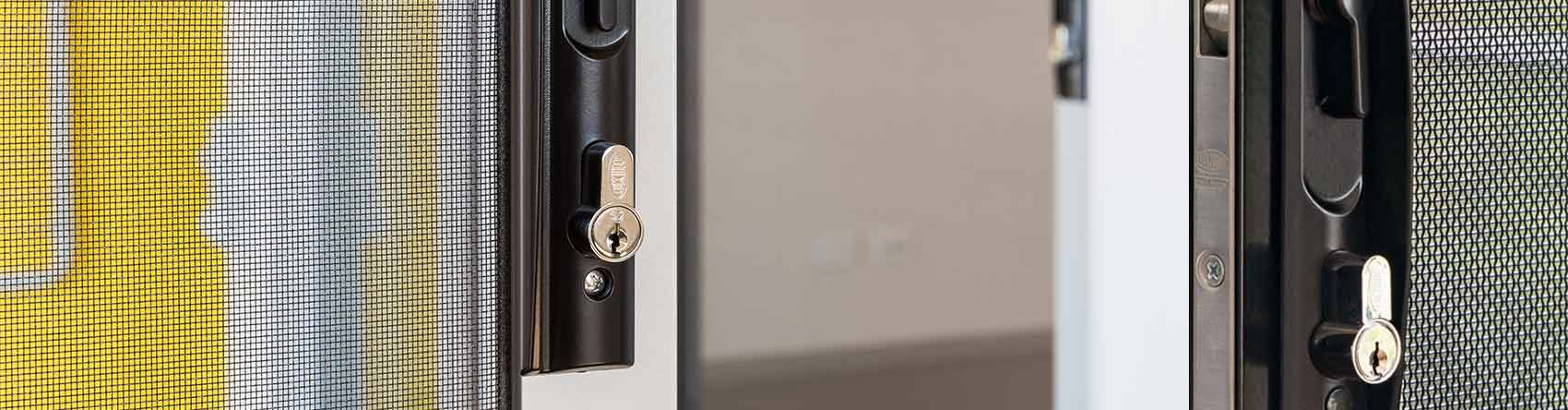
Prowler Proof uses genuine Lockwood triple-point locks across its security door range. Its hinged security doors use the Lockwood 8654 triple-point lock, while sliding security doors use the Lockwood 8653 triple-point lock.
Why does a security door need three locking points?
Security isn’t simply about having a strong lock. The way the door is held within its frame matters too.
A single locking point concentrates the locking action in one location. A triple-point system distributes that action across three points, helping secure more of the door.
This becomes particularly important when considering forced-entry attempts, where an intruder may try to pry or jemmy the door.
Prowler Proof’s security doors are tested against the Australian Standard for security screens, AS 5039. The standard includes testing designed to assess resistance to attacks including jemmying, pulling and impact.
For Prowler Proof security doors, the three-point locking system forms part of the overall security system rather than being an isolated feature.

Is a triple-point lock more secure than a single-point lock?
For a security application, a triple-point lock provides greater protection than a single-point lock.
But it’s important to put that statement into context.
A triple-point lock is only one part of a security door. The strength of the frame, infill, hinges, fixing method, lock, strike plates and installation all contribute to the finished product’s performance.
That’s why Prowler Proof doesn’t treat the lock as a standalone feature.
Its security doors are designed as complete systems and tested to AS 5039. Prowler Proof also manufactures its doors in its own automated factory, using the same manufacturing process for the products that undergo independent testing.
What is the difference between a single-point and triple-point lock?
At a glance, the difference is straightforward:
| Single-point lock | Triple-point lock | |
|---|---|---|
| Locking points | One | Three |
| Primary purpose | Barrier | Security |
| Prowler Proof application | Available where security isn’t the priority | Standard on security doors |
| Security against forced entry | Lower | Higher |
| Best suited to | Basic screening and non-security applications | Homes where security is a priority |
The important takeaway is that the right choice depends on the purpose of your door.
If you’re buying a security door specifically to improve protection against forced entry, the triple-point option is the appropriate choice.
Does every Prowler Proof door need a triple-point lock?
If you’re purchasing a security door, yes, the locking system is different from the barrier-door options.
Prowler Proof’s product information states that security doors require a three-point lock and a five-pin cylinder to meet AS 5039 requirements.
The single-point option is available where the door is being used as a barrier and security isn’t the priority.
That distinction is important when comparing products: a door may look similar from the outside, but its intended application and locking hardware can be very different.
Does the lock matter more than the security mesh?
It’s not really an either/or question.
A strong security mesh with a weak locking system isn’t an ideal security solution. Likewise, a high-quality lock can’t compensate for a poorly constructed or installed door.
Think of a security door as a complete system.
The infill provides the barrier.
The frame provides the structure.
The hinges and fixings connect the door to the opening.
The lock and locking points secure the door in place.
And the installation brings all those components together.
That’s why it’s worth looking at the complete specification when comparing security doors rather than focusing on a single feature.

Which lock should you choose?
If you’re comparing Prowler Proof locking options, the decision can be relatively straightforward.
Choose a single-point lock if:
- You’re looking for a barrier rather than a security door.
- Security against forced entry isn’t a primary concern.
- Your priority is screening, airflow or keeping insects out.
Choose a triple-point lock if:
- Security is an important reason for installing the door.
- You want the door secured at three points.
- You’re looking for a security screen tested to AS 5039.
- You want a Prowler Proof security door with genuine Lockwood triple-point hardware.
Single-point vs triple-point: the bottom line
So, which is better?
Neither is universally “better” — they are designed for different purposes.
A single-point lock can be a sensible choice when you need a barrier door and security isn’t the priority.
A triple-point lock is the more appropriate choice when you’re investing in a security door and want the additional protection of locking the door at three points.
For homeowners comparing security doors, the important thing is to look beyond the number of locking points. Consider the lock brand, the door construction, the infill, the frame, the fixing system, testing and installation as part of the complete security solution.
Prowler Proof combines genuine Lockwood triple-point locks with its security screen construction and Australian Standard testing to create a complete security door system.
If you’re still deciding which option is right for your home, request a quote from Prowler Proof and speak with a certified local dealer about your requirements.
Ready to compare your options? Request a quote from Prowler Proof and find the security door and locking system that’s right for your home.